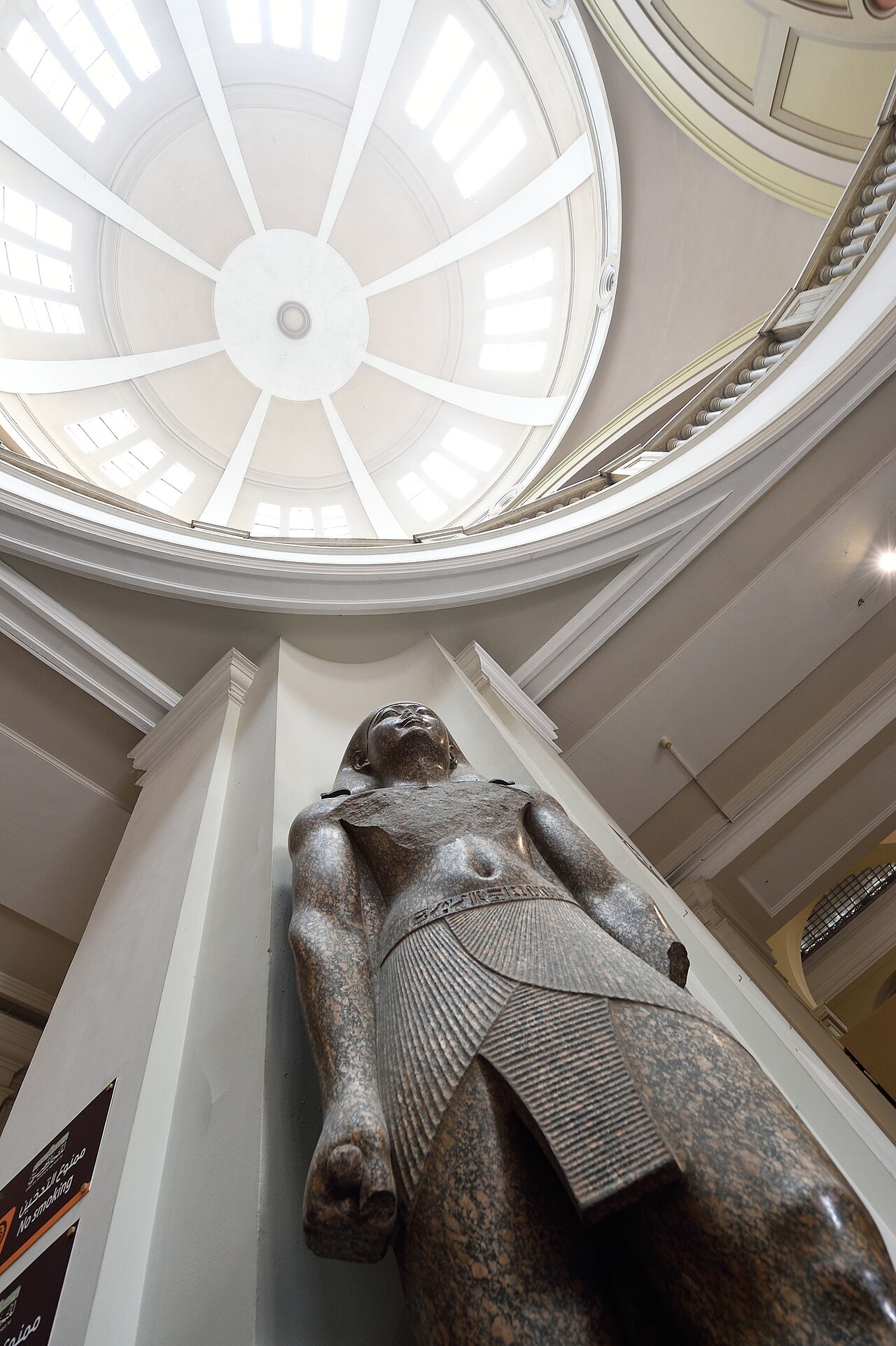
Cairo's major museums do not provide interchangeable versions of the same story. Compare the evidence each institution makes easiest to see, then choose the museum that fits your question and the practical shape of your day.
GEM: scale, sequence and ancient breadth
The Grand Egyptian Museum supports comparisons across a large ancient collection and makes monumental scale central. It suits questions about royal image, material change and long chronology. Enter with one evidence type—pose, inscription, burial group or workshop trace—so breadth becomes a controlled comparison rather than an instruction to complete everything.
Tahrir: density and museum history
The Egyptian Museum rewards visitors who can build their own object sequence in a historically significant display environment. Dense proximity can reveal variation, while older case logic becomes evidence for the history of archaeology and museums. Record inventory numbers carefully and distinguish ancient groupings from modern neighbors before turning density into context.
NMEC: cross-period synthesis
The National Museum of Egyptian Civilization frames work, belief, technology and society across a broad timeline. It is useful when the question depends on continuity and change rather than one dynasty. A synthesis museum cannot provide equal depth for every specialist topic, so note which claim needs a second institution or official collection source.
Coptic Museum: material and institutional transition
Manuscripts, textiles, carved wood, icons and architectural fragments make late antique and Coptic evidence central rather than transitional background. The museum supports questions about support, language, religious space and reuse. Old Cairo adds context, but nearby churches remain living places with their own access and worship requirements.
Museum of Islamic Art: technique and networks
The Museum of Islamic Art allows close comparison across metal, ceramic, wood, glass, textile, manuscripts and architectural surfaces. Choose one process or object function and follow it across dates. Cairo emerges as a workshop and intellectual center connected to wider routes, not an isolated style category.
Match the institution to the claim
| If you need… | Strong starting point |
|---|---|
| Ancient scale and long sequence | GEM |
| Dense object comparison and display history | Egyptian Museum, Tahrir |
| Connections across historical periods | NMEC |
| Coptic texts, textiles and architecture | Coptic Museum |
| Islamic craft and urban networks | Museum of Islamic Art |
Keep Cairo's districts honest
Giza, central Cairo, Fustat and Old Cairo require real transfers. A second museum is not a neutral add-on after security, traffic, heat and walking. Build the day around one anchor, one real break and one optional comparison. Confirm the exact entrance, current operations and specific accessibility needs through official sources.
Carry one question, not a checklist
Take an unresolved question from the first museum to the second: how context is reconstructed, how later periods are framed or how a material changes. Difference between institutions is the result, not a problem to eliminate. One tested claim creates a stronger multi-museum day than repeating famous objects.
Build a substitute before arrival
Choose a relationship, not one irreplaceable object: two royal poses, three writing supports or one material across periods. If a gallery rotates or closes, the same question can move to another case. This is especially important when temporary restrictions or conservation remove a famous work. Flexible evidence produces a successful visit without pretending that displays are permanent.
Primary sources reviewed 28 July 2026: GEM ↗ · Egyptian Museum ↗ · NMEC ↗ · Coptic Museum ↗ · Museum of Islamic Art ↗. Displays and visitor conditions may change.